

Welcome back to the ITS Podcast. In episode 85, host Junyi Ji welcomes Professor Zuduo Zheng from the University of Queensland, Australia, to explore human behavior, decision-making, and open science in intelligent transportation systems (ITS).
Zuduo reflects on human behaviour and decision making as a shared foundation of transportation research. Drawing on his work with vehicle trajectories, lane-changing, and car-following, he discusses the importance of understanding driving behaviour, examining data quality, and learning carefully from established models.
The conversation also considers open science through reproducibility and research practice. Zuduo connects these issues to imperfect data, comparative benchmarking, and the challenges of recovering the exact data and code used in earlier studies. Along the way, he shares lessons from his academic journey, perspectives on interdisciplinary collaboration, and advice on using AI thoughtfully while developing independent understanding.
In this episode
- Human factors in ITS: driving behaviour, lane-changing, and car-following research.
- Decision making: the human behaviour that connects traffic flow, travel behaviour, and safety.
- Open science in ITS: reproducibility, data quality, and comparative benchmarking.
- Literature reviews, careful use of AI, and learning from established traffic models.
- Lessons from an academic career and advice for early-career researchers.
Episode chapters
- 00:00 — Welcome, human factors, and the path into transportation research
- 12:37 — Pursuing a PhD and navigating early-career challenges
- 30:05 — NGSIM, trajectory data, and data quality
- 40:22 — Postdoctoral work, proposal writing, and resilience
- 56:56 — Literature reviews and using AI thoughtfully
- 1:17:21 — Classic traffic models and benchmarking
- 1:27:41 — Open science, reproducibility, and advice for students
About the guest
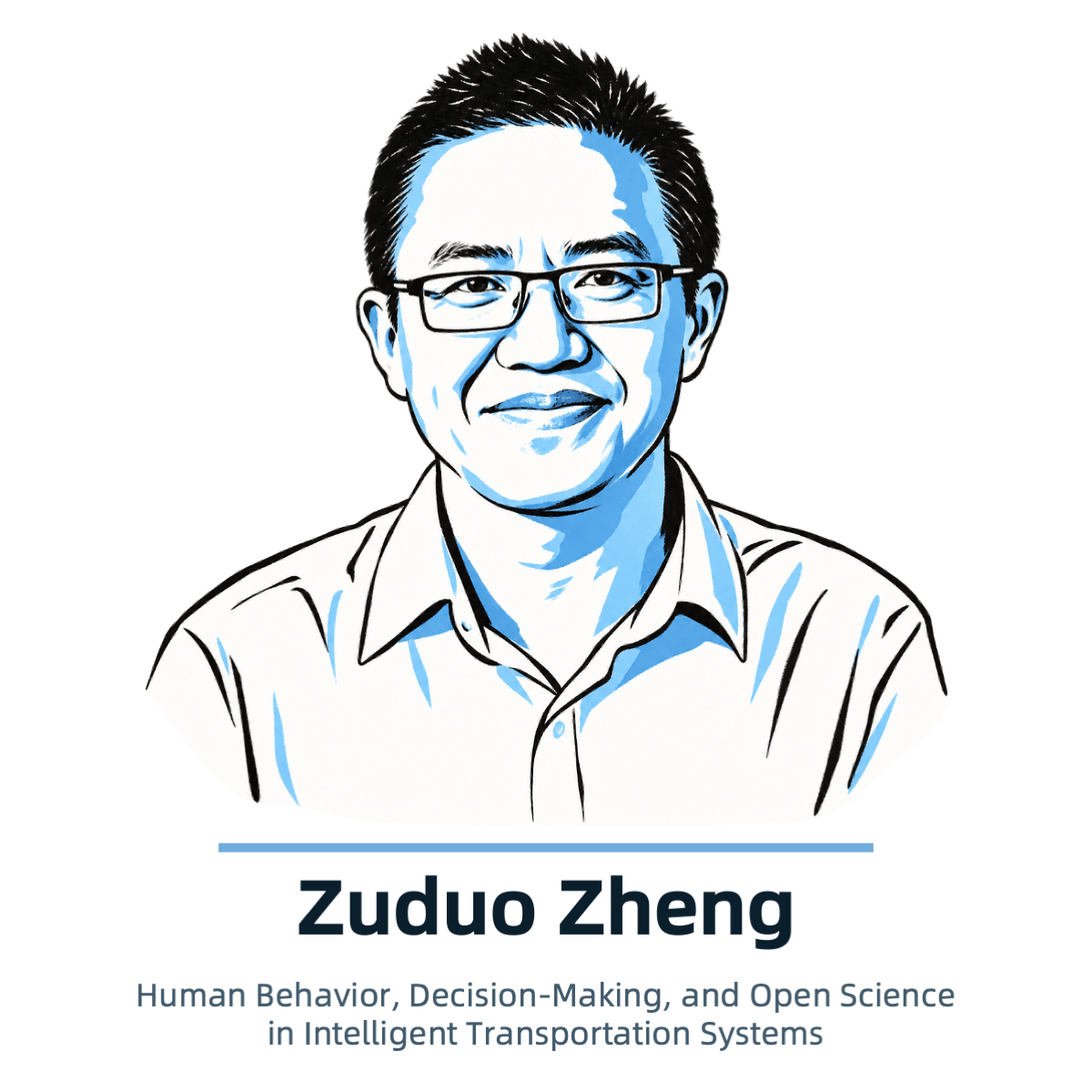
Professor Zuduo Zheng is a Professor in the School of Civil Engineering at the University of Queensland (UQ), an Australian Research Council (ARC) Future Fellow, and a member of the ARC College of Experts. He also serves as Deputy Chair of the Transport Academic Partnership, sponsored by the Queensland Department of Transport and Main Roads.
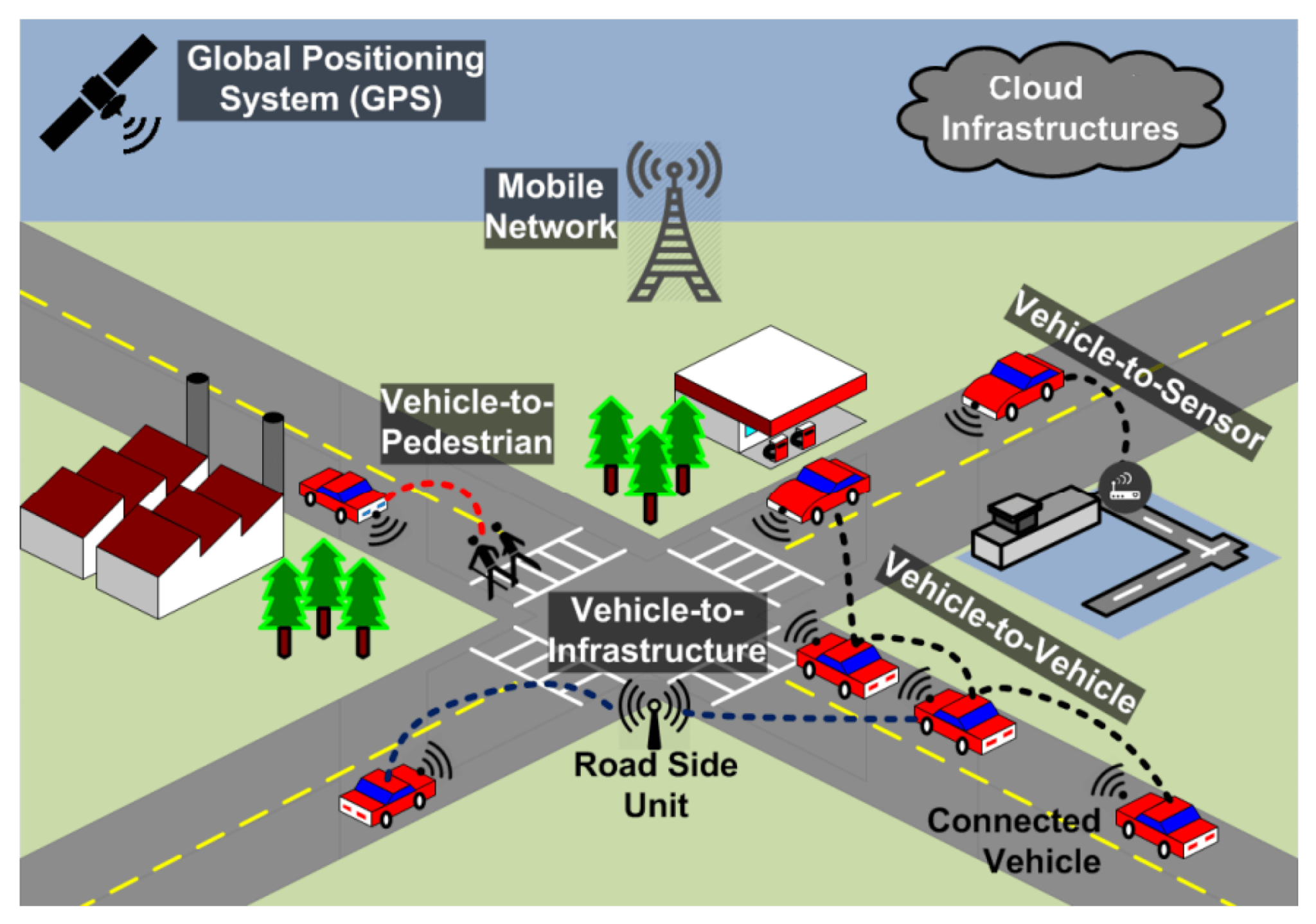
His research spans traffic flow theory, modelling, simulation and optimisation; travel behaviour and decision making; and traffic safety. He studies how connected and automated vehicles and other emerging mobility technologies affect traffic efficiency, safety, energy consumption and emissions, and develops methods for integrating these technologies into existing transportation systems.
Zuduo earned his PhD at Arizona State University and worked as a postdoctoral researcher at the Minnesota Traffic Observatory, University of Minnesota. He subsequently held academic appointments at Queensland University of Technology before joining UQ in 2018.
Alongside transportation engineering, he is interested in meta-research, reproducibility and open science. He was selected as a UQ Library Open Research Fellow for 2024, with an interest in sharing reproducible driving-simulation experiments and research manuscripts so others can repeat analyses and scrutinise findings.
Zuduo also hosts Small Talk with Myself, a free podcast for PhD students and early-career academics. Through personal reflections and conversations with experienced scholars, he explores research, mentoring, supervision, collaboration, and academic careers.
Visit Zuduo Zheng’s research website for his current projects, publications, lab facilities, and reproducible research resources.
Further reading
- Gipps’ car-following model: Gipps, P. G. (1981). A behavioural car-following model for computer simulation. Transportation Research Part B: Methodological, 15(2), 105–111.
- Gipps’ lane-changing model: Gipps, P. G. (1986). A model for the structure of lane-changing decisions. Transportation Research Part B: Methodological, 20(5), 403–414.
- Lane-changing review: Zheng, Z. (2014). Recent developments and research needs in modeling lane changing. Transportation Research Part B: Methodological, 60, 16–32.
- Human factors in car-following: Saifuzzaman, M., & Zheng, Z. (2014). Incorporating human-factors in car-following models: A review of recent developments and research needs. Transportation Research Part C: Emerging Technologies, 48, 379–403.
- Macroscopic traffic-model benchmarking: Mohammadian, S., Zheng, Z., Haque, M. M., & Bhaskar, A. (2021). Performance of continuum models for realworld traffic flows: Comprehensive benchmarking. Transportation Research Part B: Methodological, 147, 132–167.
- NGSIM data accuracy: Punzo, V., Borzacchiello, M. T., & Ciuffo, B. (2011). On the assessment of vehicle trajectory data accuracy and application to the Next Generation SIMulation (NGSIM) program data. Transportation Research Part C: Emerging Technologies, 19(6), 1243–1262.
- Critical evaluation of NGSIM: Coifman, B., & Li, L. (2017). A critical evaluation of the Next Generation Simulation (NGSIM) vehicle trajectory dataset. Transportation Research Part B: Methodological, 105, 362–377.
- Reproducible research: Reasons, challenges, and some tools for doing reproducible transportation research — Zuduo Zheng.
Host: Junyi Ji
Guest: Professor Zuduo Zheng
Duration: 1 hour 44 minutes 34 seconds
Production and Editing: Junyi Ji
Published by: ITS Podcast
This podcast is sponsored by the IEEE Intelligent Transportation Systems Society.
Music: Exploration Theme by Cleyton Kauffman, released under CC0 1.0 Universal.
© 2026 Junyi Ji and Zuduo Zheng. All rights reserved.





Leave A Comment